Before there were tiki boat franchises in 40 cities, before operators were running five tours a day on floating bars, there was a guy in Fort Lauderdale with a stolen dinghy, a patient wife, and an idea that would not let him go. The story of commercial tiki boats is not very old. But it is one of those stories where a single backyard project turned into an entire industry, and the ripple effects are still playing out today.
To understand where tiki boats came from, you have to understand tiki culture itself. And to understand where the industry is headed, you have to know about Cruisin' Tikis, the brand that started it all.
Tiki Culture: The Land-Based Origins
Tiki culture in America traces back to 1934, when a restless traveler named Ernest Gantt opened Don the Beachcomber in Hollywood, California. The bar served rum drinks in ceramic mugs, decorated with bamboo and carved masks, and transported guests to an imaginary South Pacific paradise. It was escapism in a glass, and Depression-era America could not get enough of it.
After World War II, returning GIs who had been stationed in the Pacific brought a genuine affection for the tropics back home with them. That nostalgia fueled a tiki explosion through the 1950s and 1960s. Tiki bars popped up in every city. Tiki-themed restaurants, motels, and bowling alleys followed. The aesthetic was everywhere.
Tiki culture faded in the 1970s, dismissed as kitschy and dated. But it never fully went away. By the 2000s, a revival was underway, driven by craft cocktail bartenders rediscovering classic tiki recipes and a new generation that found the whole vibe genuinely fun rather than ironic. That revival set the stage for what came next.
Greg Darby and the First Cruisin' Tiki
The commercial tiki boat industry has a very specific origin story, and it starts with a theft. Around 2014, Greg Darby, an electrical engineer and CEO of a data center company in Fort Lauderdale, had his 12-foot dinghy stolen. He and his wife Karen had been using it for casual trips up and down the New River and out to the Intracoastal Waterway. Losing the boat left a hole in their routine.
Karen suggested building a tiki hut in their backyard. Greg, being an engineer, took the idea in a different direction entirely. He started sketching plans for a tiki bar that could float. Then, as he later described it, he "got carried away and designed it with a motor."
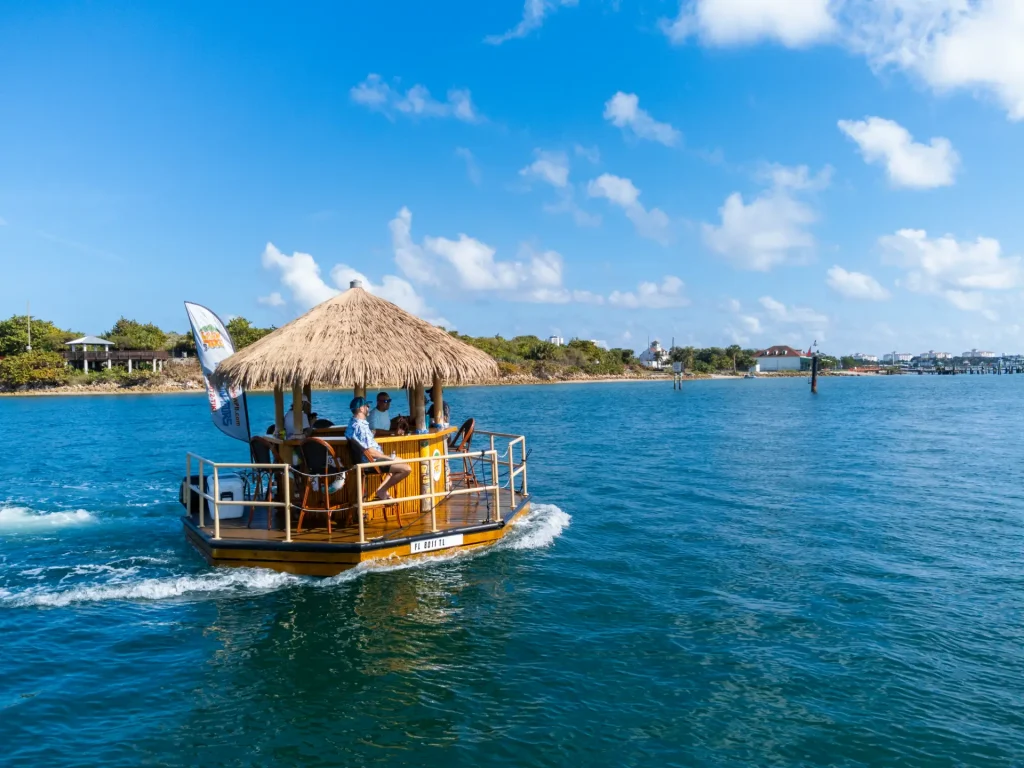
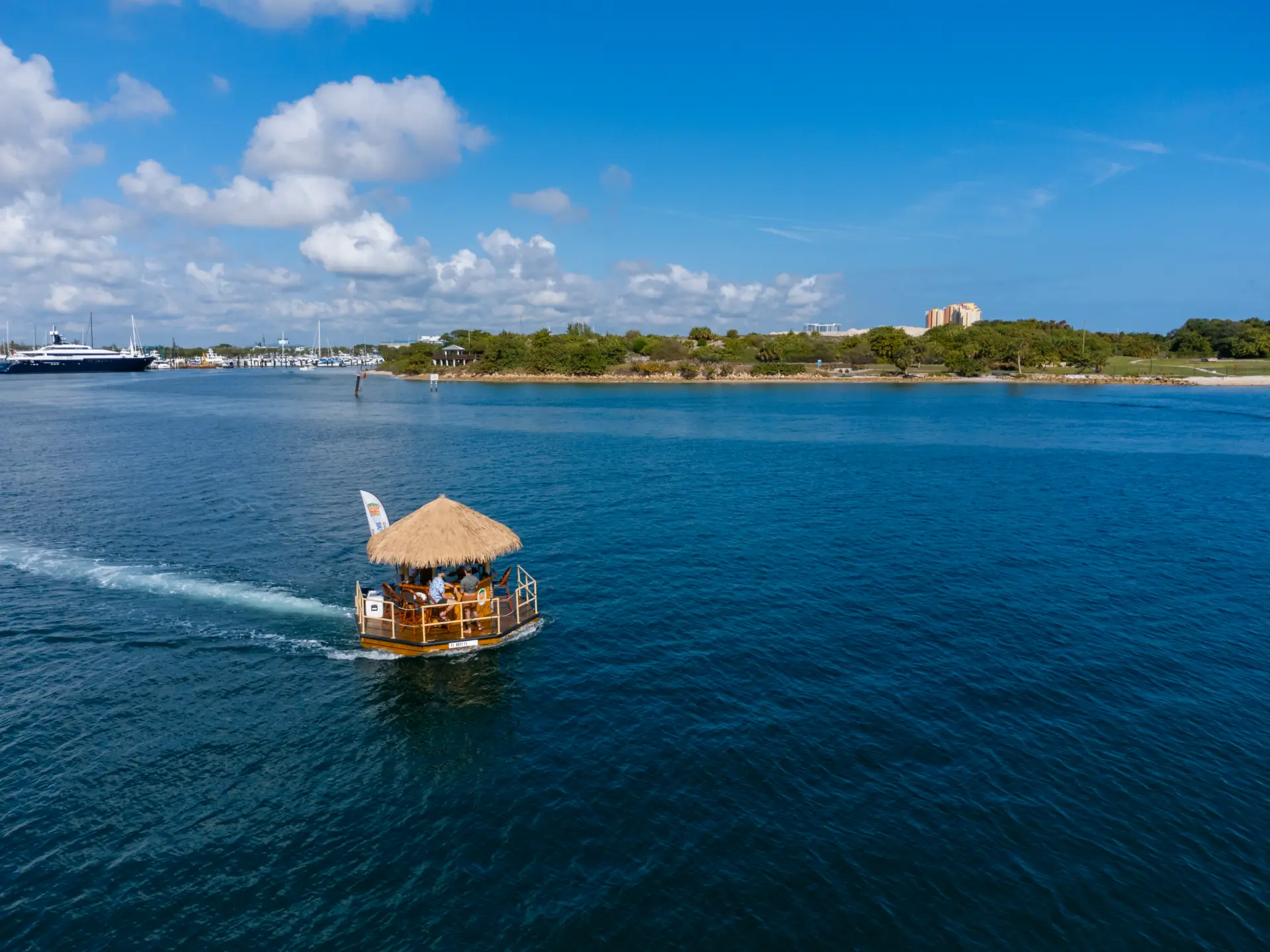
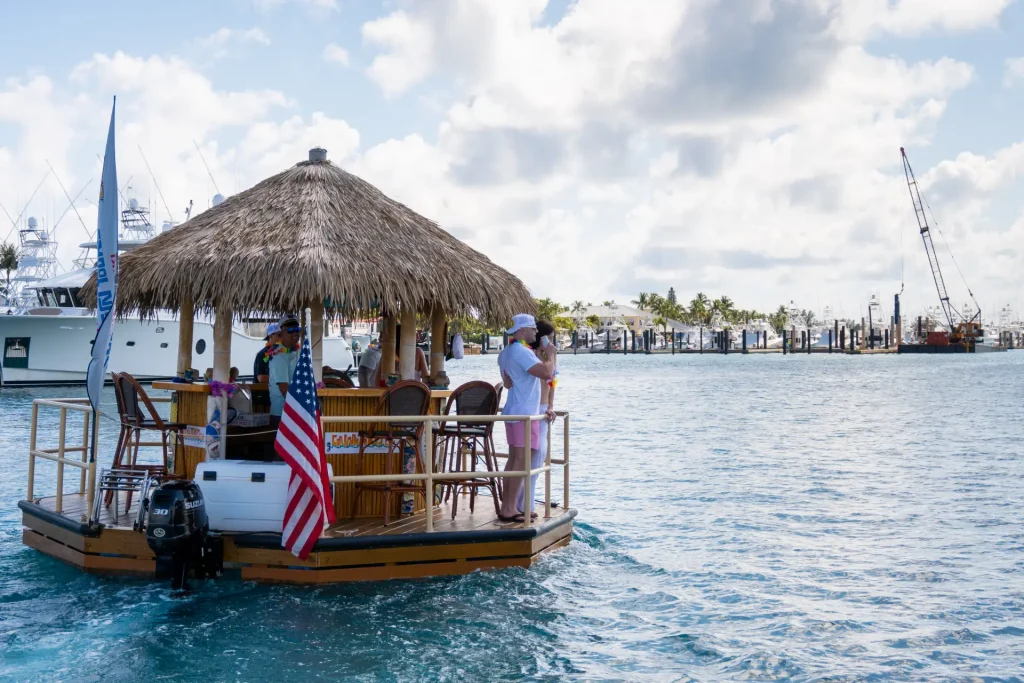
By November 2015, Greg was building the first Cruisin' Tiki in their backyard. The design was distinctive from the start. An octagonal platform with a thatched palm roof, a center bar, seating for a small group, and a motor tucked underneath. It looked like nothing else on the water. When he finally launched it on the New River in early 2016, it stopped traffic. Boaters slowed down to stare. People on shore pointed and took photos. The local media picked it up almost immediately.
Here is the detail that tells you everything about what Greg had stumbled onto: he received orders for additional boats before the first one even hit the water. People saw it being built and wanted one. The demand was that immediate and that obvious.
From Backyard Project to National Franchise
What happened next moved fast. Within months of that first launch, Darby was filling orders for boats headed to Florida, Georgia, Canada, and Mexico. Early units were priced at $16,500 for a non-powered version and $21,500 with a motor and a six-year Suzuki warranty. By the standards of commercial marine equipment, those were remarkably accessible price points.
By 2018, the Darbys formalized the business as a franchise, creating Cruisin' Tikis International. The franchise model let entrepreneurs in different markets buy a boat and operate under the Cruisin' Tikis brand, with training, operational support, and the built-in name recognition that the brand had already earned through years of media coverage and social media virality.
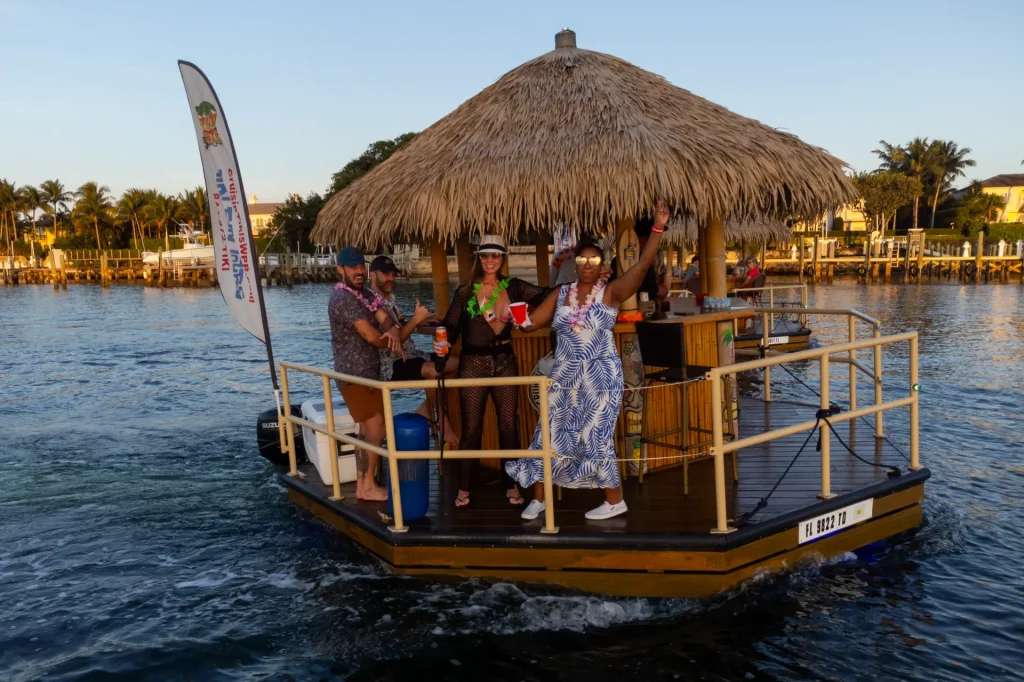
The growth from there was explosive. Locations opened in coastal towns, lake communities, river cities, and anywhere with navigable water and tourists looking for something to do. Bachelorette parties discovered them. Corporate event planners discovered them. Families on vacation discovered them. Every trip generated a dozen social media posts, and every post generated more bookings.
Greg Darby passed away in June 2023, but the company he built continued under Karen Darby's leadership, honoring his legacy and the vision he had sketched out on that first set of drawings. By the time of his passing, Cruisin' Tikis had become the single most recognized tiki boat brand in the country.
Timeline: Key Moments in Tiki Boat History
Don the Beachcomber opens in Hollywood, California, launching American tiki culture and creating the aesthetic that would eventually inspire floating tiki bars decades later.
Post-war tiki boom. Returning GIs fuel a nationwide obsession with Polynesian-themed bars, restaurants, and entertainment venues. The tiki aesthetic becomes embedded in American pop culture.
Tiki revival begins. Craft cocktail bartenders rediscover classic tiki recipes, and a new generation embraces the culture. The stage is set for tiki to move beyond the bar.
Greg Darby's dinghy is stolen in Fort Lauderdale. His wife Karen suggests building a backyard tiki hut. Greg, an electrical engineer, starts designing a floating version with a motor instead.
Greg begins construction of the first Cruisin' Tiki in the Darby backyard. Orders start coming in before the boat even touches water.
The first Cruisin' Tiki launches on the New River in Fort Lauderdale. Local media coverage follows immediately. Boats begin shipping to Florida, Georgia, Canada, and Mexico.
Cruisin' Tikis International launches its franchise model, allowing entrepreneurs across the country to operate their own tiki boat businesses under the brand.
Other manufacturers enter the market. Sculpin Marine introduces Palapa Pontoons, A&M Manufacturing launches their tiki boat line, and MyTikiBoat.com begins production. The commercial tiki boat becomes a recognized vessel category.
Post-pandemic tourism surge sends demand through the roof. Tiki boat operations become one of the fastest-growing segments in experiential tourism. Franchise locations multiply across the Sun Belt and Midwest.
Greg Darby passes away in June. Karen Darby continues leading Cruisin' Tikis, honoring his legacy. The brand now operates over 100 boats in 40+ markets nationwide.
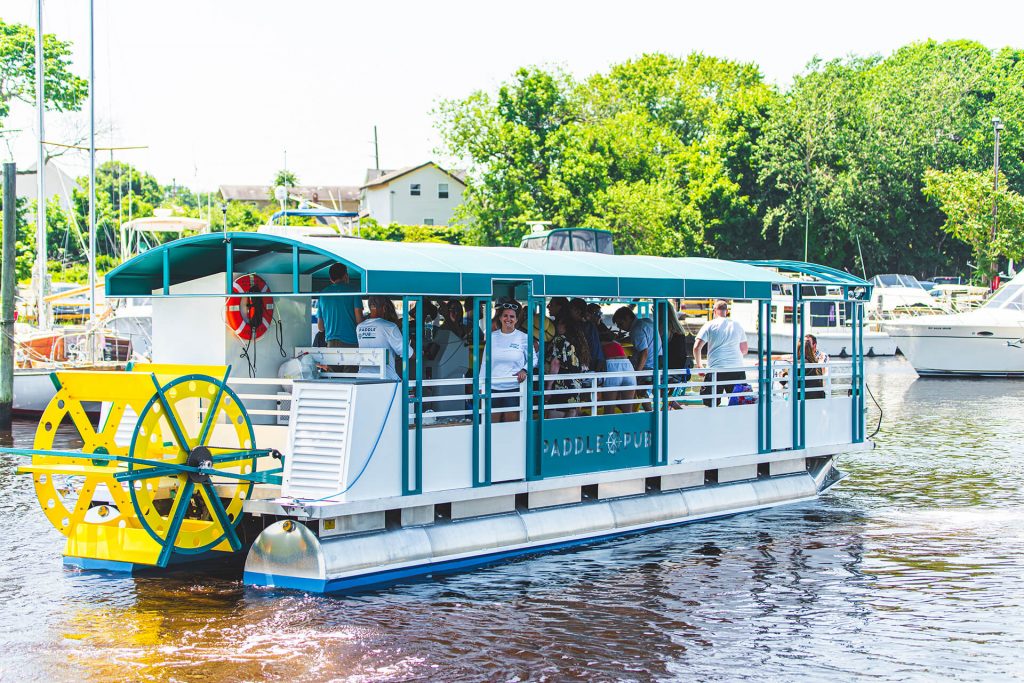
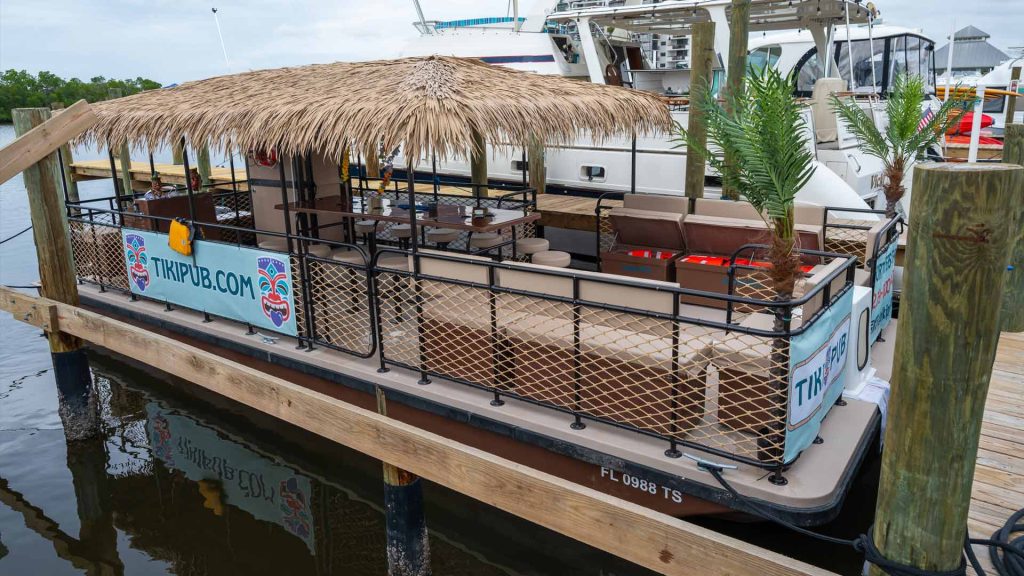
TourScale acquires Cruisin' Tikis, adding it to a portfolio that includes Trolley Pub, Paddle Pub, and Tiki Pub. TourCraft serves as the exclusive manufacturer of Cruisin' Tikis and Tiki Pub vessels, building every boat to commercial standards.
The Original Head Turner
There are other tiki boat brands on the market today. Sculpin Marine builds their Palapa Pontoons for commercial operators. A&M Manufacturing offers several models, including the Tiki 6-Pack (a TourCraft exclusive) and Salty 26. MyTikiBoat.com produces a 26-foot model rated for 18 passengers plus crew. Each manufacturer has its own approach to hull design, materials, and construction.
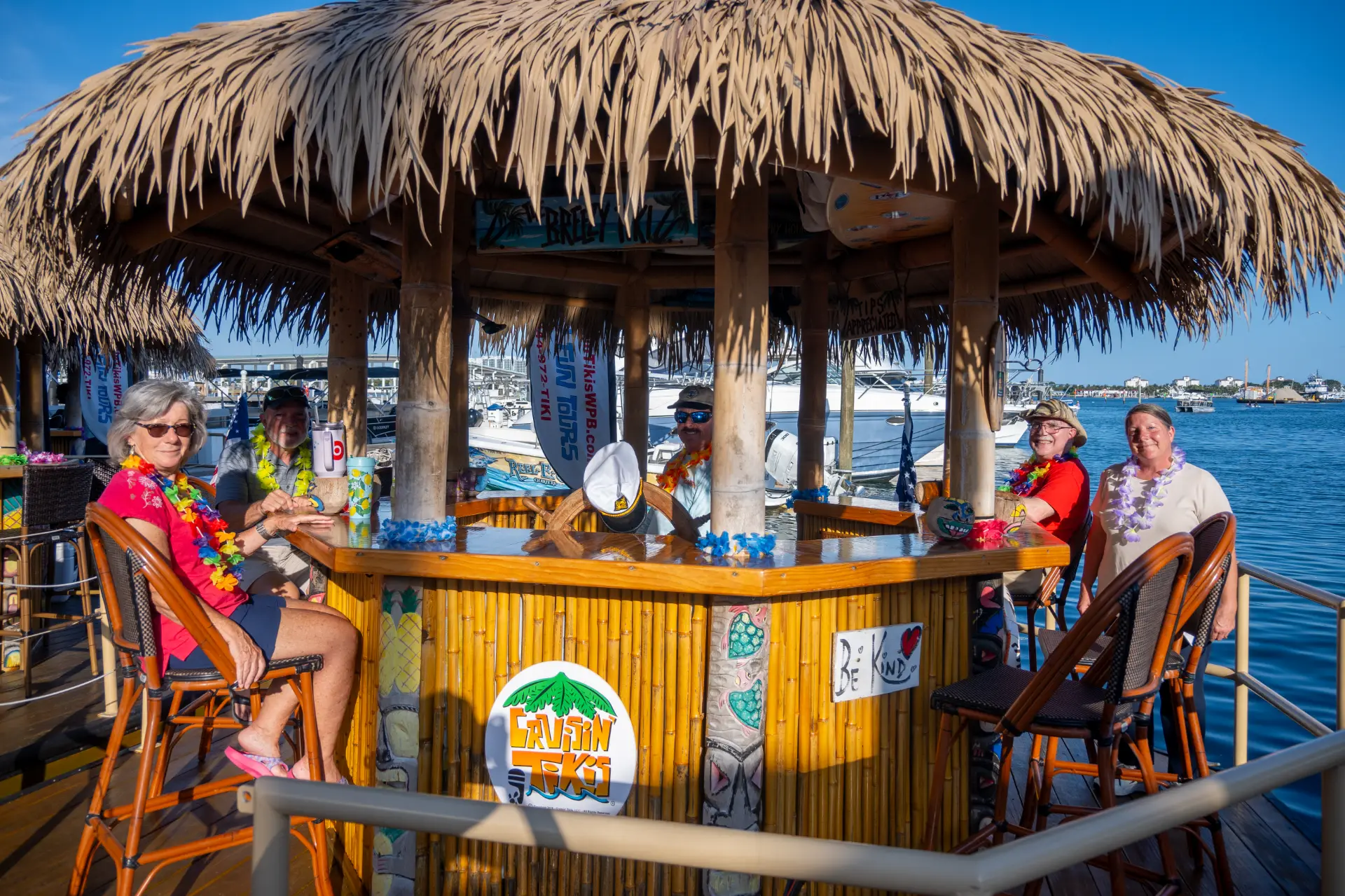
But Cruisin' Tikis remains by far the most popular tiki boat brand in America, and the original head turner. When people think "tiki boat," they picture that octagonal platform with the thatched roof and the center bar. That is the Cruisin' Tikis design. It is what started the industry, what proved the concept commercially, and what continues to set the standard that other brands are measured against.
Part of what makes Cruisin' Tikis special is the attention to authenticity. The early boats featured natural palm fronds hand-woven into the roof by artisans from the Seminole Tribe, connecting the vessels to the real Floridian and Polynesian craft traditions rather than snapping on some synthetic thatch from a catalog. That commitment to quality and character has defined the brand from day one.
TourCraft: The Manufacturer Behind the Brand
Today, TourCraft is the exclusive manufacturer of both Cruisin' Tikis and Tiki Pub vessels. Every new Cruisin' Tikis boat rolling off the line is built by TourCraft, using marine-grade materials, commercial construction methods, and the kind of engineering that holds up to daily tour operations year after year.
That relationship is not a coincidence. TourCraft was founded by operators who ran their own pedal boat tour company and understood firsthand what commercial vessels need to survive the real world. Things like modular pontoon construction that simplifies maintenance. Composite TimberTech decking that handles thousands of boarding cycles without deteriorating. Aluminum framing that outlasts fiberglass in commercial use. Suzuki outboards backed by robust warranty coverage. These are the details that determine whether a boat is still generating revenue in year ten or sitting at the dock waiting for repairs.
TourCraft currently builds Cruisin' Tikis models in 16-foot and 20-foot configurations, each designed for the specific demands of tour operations. The 16-foot model is ideal for smaller groups and calmer waterways. The 20-foot model handles bigger parties and busier markets. Both are built to meet USCG standards for commercial passenger vessels, which is a non-negotiable requirement for any legitimate tour operation.
Why Tiki Boats Took Off When They Did
It is worth asking why commercial tiki boats exploded in the mid-2010s rather than, say, the 1990s or 2000s. The tiki aesthetic had been around for decades. Pontoon boats existed. Bars existed. Combining them was not exactly rocket science. So what changed?
Three things converged at once. First, the experience economy had reached critical mass. By the mid-2010s, consumer spending had decisively shifted from things to experiences, particularly among millennials who were entering their peak spending years. A floating tiki bar is an experience in its purest form.
Second, social media had matured into a visual discovery engine. Instagram launched in 2010 and reached a billion users by 2018. TikTok followed. A tiki boat is inherently photogenic and shareable. Every single trip generates organic content that markets the business without the operator spending a dollar on advertising. Greg Darby could not have timed it better if he tried.
Third, cities were investing heavily in waterfront revitalization. From Tampa to Milwaukee to Nashville, municipalities were pouring money into riverwalk developments, marina districts, and public waterfront spaces. These developments needed anchor experiences to attract visitors, and tiki boats fit the bill perfectly. They activate the waterfront without requiring permanent infrastructure, and they draw the exact demographic that cities want in their new developments.
The Industry Today
As of early 2026, the commercial tiki boat industry looks nothing like it did even five years ago. What started with one man and one boat in Fort Lauderdale has become a recognized segment of the marine entertainment market. Cruisin' Tikis alone operates over 100 boats in more than 40 locations. When TourScale acquired Cruisin' Tikis in January 2025, the deal brought the brand under the same umbrella as Trolley Pub, Paddle Pub, and Tiki Pub, creating the largest portfolio of experiential tour brands in the country.
The market has also matured in how it builds and regulates these vessels. Early tiki boats were essentially modified recreational platforms. Today, any serious commercial operation requires USCG Sub-Chapter T certification, proper marine insurance, and vessels built specifically for the demands of daily tour service. That is where having a manufacturer like TourCraft matters. Building a boat that looks good in a photo is easy. Building one that still looks good and runs reliably after 1,500 tours is the real challenge.
What Comes Next
The tiki boat industry is still young. Greg Darby built his first boat barely a decade ago. The franchise model is less than eight years old. There are still hundreds of viable markets across the United States that do not have a single tiki boat operation. International expansion is just beginning. And the vessels themselves continue to evolve, with better electronics, more efficient motors, improved passenger comfort, and construction techniques refined through thousands of hours of real-world commercial use.
What will not change is what made tiki boats work in the first place. People want to be on the water. They want to be with friends. They want a drink in their hand and a roof over their head and a story to tell afterward. Greg Darby figured that out in his backyard in 2015. The rest of the industry has been catching up ever since.
TourCraft is the exclusive manufacturer of Cruisin' Tikis and Tiki Pub vessels. Whether you are launching your first tiki boat operation or expanding an existing fleet, our team can walk you through model options, specifications, and timelines. Get in touch to start the conversation.
Contact UsTourCraft Team
Commercial Boat Manufacturer